
Manor Leas Infant School
SEND Information Report
Manor Leas Infant School Special Educational Needs & Disabilities (SEND) Information Report.
Introduction
Manor Leas Infant School is an inclusive school. We aim to offer excellence and choice to all our children, regardless of attainment or needs. We have high expectations of all our children. We aim to achieve this through the removal of barriers to learning and participation, ensuring that all our children feel that they are a valued member of our school community.
The aim of this information report is to explain how we implement our SEND policy: we want to show you how special educational needs support works in our school.
If you want to know more about our arrangements for SEND, read our SEND policy on the school website.
What kinds of SEND are provided for?
The SEND Code of Practice (2014) states that:
‘A child or young person has SEN if they have a learning difficulty or disability which calls for special educational provision to be made for him or her.’
A child of compulsory school age or a young person has a learning difficulty or disability if he or she:
‘has a significantly greater difficulty in learning than the majority of others of the same age or has a disability which prevents or hinders him or her from making use of facilities of a kind generally provided for others of the same age in mainstream schools.’
There are 4 broad area of need in the SEND Code of Practice: Communication and Interaction; Cognition and Learning; Social, Emotional & Mental Health; Sensory &/or Physical.
|
Area of need |
Condition |
|
Communication and interaction |
Autism spectrum disorder (ASD) |
|
Speech and language difficulties |
|
|
Cognition and learning |
Specific learning difficulties, including dyslexia, dyspraxia, dyscalculia |
|
Moderate learning difficulties |
|
|
Severe learning difficulties |
|
|
Social, emotional and mental health
|
Attention deficit hyperactivity disorder (ADHD) |
|
Attention deficit disorder (ADD) |
|
|
Sensory and/or physical |
Hearing impairments |
|
Visual impairment |
|
|
Multi-sensory impairment |
|
|
Physical impairment |
|
|
Downs Syndrome |
|
|
Medical Needs |
How do we identify pupils with SEND and assess their needs?
If a parent has concerns about their child’s needs, contact the child’s class teacher. It is beneficial to identify a child’s needs early so please contact us.
If staff have concern about a child’s progress or needs, the teacher will contact the parent to discuss these concerns.
A child may express concerns about their progress or needs, and these views will need to be shared with staff and parents.
ALL PUPILS: All children need support at some points of a particular lesson, topic or strategy. This is high quality teaching. All teachers are trained to adapt their teaching to the needs within their class, and all children will receive support as and when it is needed in lessons.
SOME PUPILS: experience times in their education when a need emerges. At this point there may be some small group interventions and resources put in place to support them. These interventions may be delivered within the classroom or as weekly sessions with a specific focus being taught. At this stage your child will be being monitored for SEND because they are having additional support.
SEND PUPILS: may need ongoing support with a certain area of need. At this stage there is usually some involvement, assessment or review from outside agencies. Such services provide additional strategies that school and home can implement to support the child. At this stage your child will be placed on the SEND register because they are having SEND support.
EHCP PUPILS: A small number of pupils need support beyond what the school can provide through ordinarily available provision. These pupils may require long-term support for their education and school (or parents) can request an Education, Health, Care Plan (EHCP) for more continuous support.
This process is best shown by the table on the next page.
|
Stage 1 All pupils – High quality teaching
|
Stage 2 Some pupils - Monitoring |
Stage 3 SEND pupils – SEND Support |
Stage 4 SEND pupils - EHCP |
|
|
|
|
|
|
Area of need identified by class teacher: Communication and Interaction; Cognition and Learning; Social, Emotional & Mental Health; Sensory &/or Physical.
|
Teacher to meet with parents- discuss progress, needs, adaptations tried and parent views. Teacher and parents to complete the monitoring form and give to SENDCo. |
Teacher to complete a Pupil Profile, identifying needs, support, and outcomes to focus on. |
Collate all paperwork. Complete VSEND. |
|
|
|
|
|
|
SENDCo Action-observe and/or talk to child / meet with parents if needed. |
Child is placed on SEND register. Profiles are sent to parents each term for agreement or alteration. |
Apply for EHCP. (There is no guarantee that an EHCP will be agreed. Evidence of a year of SEND support and reports from numerous professionals is usually required.) |
|
|
|
|
|
|
|
Teacher to make adaptations to teaching to accommodate child’s need. |
Child added to the monitoring section of the SEND register. |
Referrals to other professionals may be made. |
|
|
|
|
|
|
|
Progress is monitored each term for at least one term. |
Progress is monitored each term for at least 3 terms. |
If an EHCP application is successful, then this document will tell parents and school how the child will be supported. This will be reviewed annually. |
|
|
|
|
|
|
|
Is the child making progress? Yes-remain at this stage. No-move onto stage 2. |
Is the child making progress? Yes-remain at this stage. No-move onto stage 3. |
Is the child making progress? Yes-remain at this stage. No-move onto stage 4 |
Green Boxes = Teacher responsibility
Yellow Boxes = SENDCo responsibility
What will school do to assess and review a child’s progress?
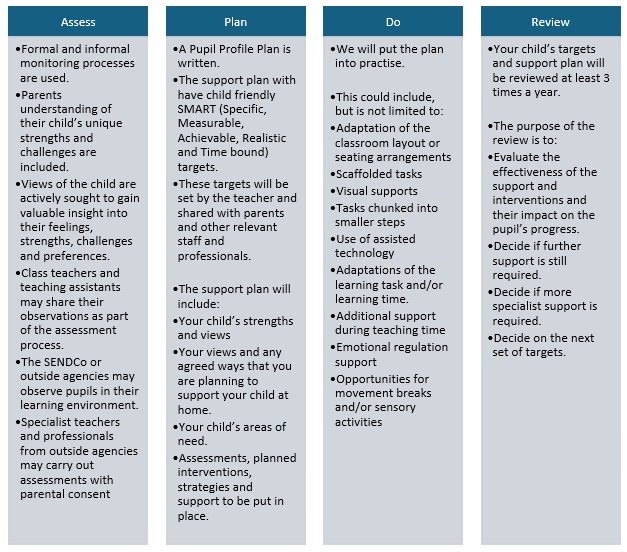
We use the ‘Graduated Approach’ to support pupils, using a process called Assess, Plan, Do, Review.
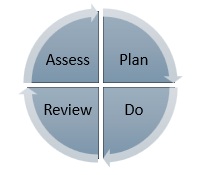
Your child will have targets set and their progress will be monitored by the class teacher, however they may receive support from Teaching Assistants, other teachers or agency support workers. The process of providing support is:
Staff who support SEND pupils in School and their training.
The Head Teacher, Miss Claire Turner, is responsible for ensuring that the Special Educational Policy is implemented and managed. They are undertaking their National Professional Qualification in Special Education Needs Co-ordination.
The SENDCo, Mrs Emma Watkinson, is responsible for coordinating the day-to-day provision of education for pupils with special educational needs and disabilities. They monitor the provision, liaise with outside agencies, and provide advice for parents and staff.
The SENDCo has 13 years of experience in this role, has worked in education for 26 years and are a qualified teacher. They achieved the National Award in Special Educational Needs Co-ordination in 2014, gained a master’s in psychology in 2019 and are also a qualified Mental Health First Aider since 2019.
They are allocated 10 hours a week to manage SEND provision.
The SEND Trustee, Mrs Kelly Hall, is the member of the trustee board who has specific oversight of the school’s arrangements for SEND.
Class teachers make adaptations to meet the needs of all learners, receive regular SEND training, (Attention Autism, Executive Functioning, Use of reasonable Force, Behaviour Management, Child Protection) and are supported by the SENDCo to meet the needs of pupils who have SEND. They are are responsible and accountable for the progress and development of all pupils in their class, even where pupils access support from teaching assistants or specialist staff.
We have a team of 8 Teaching Assistants (TAs), who are trained to deliver SEND provision. 2 who are trained as an Emotional Literacy Support Assistants (ELSA). TAs have been trained in: ELKAN, Autism Awareness, Higher Level Teaching Assistant, Coaching and Mentoring, Behaviour Management, Child Protection, Early Bird Programme, Attunement through play and Sensory Circuits.
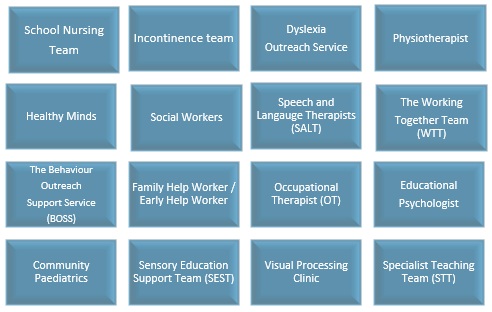
External agencies and experts are professionals who work outside school in SEND, Health and Social care. Sometimes we need extra help to offer our pupils the support they need. Whenever necessary we will work with external support services to meet the needs of our pupils with SEN and to support their families.
These include:
How will I be involved in decisions made about my child’s education?
Your child’s class teacher will meet you for 2 parent meetings per year which take place in the Autumn and Spring terms; provide termly Pupil Profile reviews and an annual report on your child's progress.
The parent meetings and Pupil Profile reviews will:
- Set clear outcomes for your child’s progress
- Review progress towards those outcomes
- State the support we will put in place to help your child make that progress
- Identify what we will do, what we will ask you to do, and what we will ask your child to do
The SENDCo may also attend these meetings, or hold separate meetings, to provide extra support.
We aim to make sure you have a full understanding of how we are trying to meet your child’s needs, so that you can provide insight into what you think would work best for your child. We also want to hear from you so that we can build a better picture of how the SEND support we are providing is impacting your child outside of school. After any discussion we will make a record of any outcomes, actions and support that have been agreed. If you have concerns that arise between these meetings, please contact your child’s class teacher
How will my child be involved in decisions made about their education?
The level of involvement will depend on your child’s age and level of understanding. We recognise that no 2 children are the same, so we will decide on a case-by-case basis.
We seek your child’s views by asking them to:
- Attend meetings to discuss their progress and outcomes
- Prepare photographs, written statements, videos, drawings, etc.
- Discuss their views with a member of staff who can act as a representative during the meeting
- Complete a survey
How will the school adapt its teaching for my child?
Your child’s teacher is responsible and accountable for the progress and development of all the pupils in their class. High quality teaching is our first step in responding to your child’s needs. We will make sure that your child has access to a broad and balanced curriculum in every year they are at our school.
We will adapt (or differentiate) how we teach to suit the way the pupil works best. There is no '1 size fits all’ approach to adapting the curriculum, we work on a case-by case basis to make sure the adaptations we make are meaningful to your child.
These adaptations include:
- Adapting our curriculum to make sure all pupils can access it, for example, by grouping, 1:1 work, adapting the teaching style or content of the lesson, etc.
- Adapting our teaching, for example, giving longer processing times, pre-teaching of key vocabulary, reading instructions aloud, etc.
- Adapting the environment by having quieter corners, available resources, working walls and easily accessible scaffolds.
- Adapting our resources and staffing.
- Using recommended aids, such as laptops, coloured overlays, visual timetables, larger font, etc.
- Teaching assistants will support pupils on a 1:1 basis when delivering a specific intervention and support for personal care skills or will support pupils in small groups when aiding with access to the curriculum and teaching social skills.
We may also provide the following interventions:
|
Area of need |
Whole school ethos and practice (ALL PUPILS) |
Possible focussed support for some children’s additional needs (SOME PUPILS) |
Possible support and intervention for SEND who may or may not have an EHCP (SEND PUPILS) |
|
Communication and Interaction
Autism
Speech and language delay |
|
|
|
|
Area of need |
Whole school ethos and practice (ALL PUPILS) |
Possible focussed support for some children’s additional needs (SOME PUPILS) |
Possible support and intervention for SEND who may or may not have an EHCP (SEND PUPILS) |
|
Cognition and Learning
Specific Learning Difficulties
Moderate Learning difficulties |
|
|
|
|
Social Emotional, & Mental Health
AD(H)D
|
|
|
|
|
Area of need |
Whole school ethos and practice (ALL PUPILS) |
Possible focussed support for some children’s additional needs (SOME PUPILS) |
Possible support and intervention for SEND who may or may not have an EHCP (SEND PUPILS) |
|
Sensory and/or Physical
Visual Impairment
Hearing Impairment
Multi-sensory Impairment
Physical Impairment
Downs Syndrome
Medical Needs |
|
|
|
How will the school resources be secured for my child?
It may be that your child’s needs mean we need to secure:
- Extra equipment or facilities
- More teaching assistant hours
- Further training for our staff
- External specialist expertise
If that’s the case, we will consult with external agencies to get recommendations on what will best help your child access their learning.
How will the school make sure my child is included in activities alongside pupils who don't have SEND?
- All of our extra-curricular activities and school visits are available to all our pupils, including our before and after-school clubs.
- All pupils are encouraged to go on our school trips, including any overnight stays and trips. We complete very thorough risk assessments and can enhance these with additional Individual risk assessments.
- All pupils are encouraged to take part in special school events such as assemblies, plays and performances, sports days and special workshops inside school.
- No pupil is ever excluded from taking part in these activities because of their SEND and we will make whatever reasonable adjustments are needed to make sure they can be included.
How does the school support pupils with disabilities?
Manor Leas Infant School recognises the importance of making the school accessible to all, both in the curriculum and where possible in all areas of the school premises and facilities.
The school site that is all on one level. The main entrance has a ramp and a wide door to allow wheelchair access. EYFS and Year One classroom doors have ramp access. There is a wheelchair accessible disabled toilet, which is large enough to accommodate a shower and changing.
To support children with English as an Additional Language (EAL) we have a range of books written in several home languages and a variety of signs around school welcoming children in world languages. Where there is a need, an adult will plan in designated time to work with children with EAL across the school as part of a small group. The Speech and Language team can be contacted if there is a need to support developing vocabulary and early speech.
More information can be found in the SEND policy, and in the Accessibility Plan.
The school’s accessibility plan is available on the school website and outlines how we:
-
- Increase the extent to which disabled pupils can participate in the curriculum
- Improve the physical environment to enable disabled pupils to take better advantage of the education, benefits, facilities and services you provide
- Improve the availability of accessible information to disabled pupils
Admissions of pupils with SEND
Please refer to the information in our Admissions policy.
The admission arrangements for all pupils are in accordance with national legislation including the Equality Act 2010. This includes children with any level of SEND, those with Education, Health and Care (EHC) plans and those without.
Where appropriate upon transition children with identified needs will be supported through liaison meetings with parents, key staff from the setting and support agencies. No pupil will be refused admission to school on the basis of his or her SEND. We do not discriminate against any child and actively take all reasonable steps to provide effective educational provision for all children.
It is the Trustees’ policy to accommodate pupils with disabilities should parents wish and individual needs are planned for, to prevent any pupils being treated less favourably that other pupils. In practice we ensure that classroom and extra-curricular activities encourage the participation of all pupils, including those categorised as having Special Educational Needs and Disabilities. Staff organise human and physical resources within the school to increase access to learning and participation by all pupils.
How will the school support my child’s mental health, and emotional and social development?
All staff understand that the self-esteem and happiness of children is crucial to their wellbeing. Teachers, Teaching Assistants and Midday Supervisors build up strong relationships with children to support their emotional needs. A range of techniques are used in lessons to promote speaking, listening, empathy and other social rules.
- Scenarios that the children may experience are explored, and problem-solving strategies are developed using conversations, social stories, action plans, etc.
- Children are taught and encouraged to recognise, name and understand their emotions and learn tools to handle strong feelings. Self-regulation strategies from the BOSS toolkit are also used to help children regulate their emotions.
- We have a clear behaviour policy which is adhered to by all staff.
- All safeguarding concerns will be reported to Miss Turner (Designated Safeguarding Lead and Head Teacher) and recorded on our CPOMS recording system. All incidents are communicated to the relevant members of staff.
- Pupils are encouraged to be part of the school community through special events
- We provide extra pastoral support through ELSA where it is needed
- We have a ‘zero tolerance’ approach to bullying. We prevent bullying in the school by following the school’s Anti-bullying policy
- We work closely with outside agencies to support children with emotional and developmental needs
Medical needs
- If your child has specific medical needs, then please contact either your class teacher or the SENDCo so appropriate plans can be put into action.
- If needed, a ‘care plan’ can be developed, with support and advice from outside agencies, to inform all staff of the specifics of the condition and what should be done to support the needs of the child.
- If your child requires ongoing medication, please contact the school office for more information
Support for behaviour (including attendance and exclusion):
If your child has specific difficulties regarding behaviour they may have an individual plan, a Pastoral Support Plan (PSP) or an individual risk assessment. The support provided will follow the ASSESS, PLAN, DO, REVIEW process (as outlined on page 4).
What support will be available for my child as they transition between classes or settings, or in preparing for adulthood?
We have strong links with our preschools and to ensure a smooth transition we include the following actions:
- Open days give an overview of what we offer at Manor Leas Infant
- A welcome event is held in the summer term where you will meet your child’s class teacher and other relevant adults, be given information about how the school runs and find out about the order of the day and routines.
- For children joining in Reception, the Reception teacher will visit your child in their current preschool before they start, and your child will be invited for a short ‘taster’ session and a shared event with you.
- The Reception teacher meets with pre-school key persons to discuss your child’s individual needs.
- The SENDCo will speak to your child’s key worker or previous school, where appropriate, to discuss their needs.
- Parents can meet with your child’s class teacher and SENDCo, where appropriate, before they start school.
- School receives and uses relevant paperwork from the nursery or previous school, e.g. your child’s learning journey, any SEND or medical information.
Between years
To help pupils with SEND be prepared for a new school year:
- The current teacher and the next year’s teacher attend a meeting to ‘handover’ all of the pupils. ALL pupils, including those with SEND are discussed
- Lessons are scheduled with the incoming teacher towards the end of the summer term
- SEND pupils are provided with a social story of their new classroom and adults
- SEND pupils are given opportunities for small jobs and additional relationship building with new members of staff and the new environment
Between schools
When your child is moving on from our school, we will share any SEND information and records with the new setting.
If your child is joining Manor Leas Infant from another school in Years 1 or 2, you will be invited to have a look around the school and meet the class teacher. Parents can meet with your child’s class teacher and SENDCo before they start school. School receives and uses relevant paperwork from your child’s previous school, e.g. your child’s learning journey, any SEND or medical information.
Between phases
The member of teaching staff or the SENDCo from the junior or primary school will come into our school for a meeting with the children, staff and SENDCo. They will discuss the needs of all the children who are receiving SEND support. The SENDCo from the junior or primary school will be invited to attend the last review meeting of year 2 and any external agency support in place will continue through the transition.
Pupils will be prepared for the transition by:
- Completing pieces of transition curriculum work.
- Discussing any new arrangements and experiences with their current and future teacher, who will cover transition through the PSHE curriculum.
- Visiting their junior or primary school for a day-more transition visits can be arranged for pupils if appropriate.
Who should I talk to if I have a complaint about the provision for my SEND child?
The school works, wherever possible, in full partnership with parents and carers to ensure a collaborative approach to meeting pupils’ needs. All complaints are taken seriously and will be heard through the school’s complaints procedure.
In most instances complaints can be resolved at class teacher level. However, if this is not possible, please follow the school’s complaints policy, which can be found on the school website.